Tuesday, March 26, 2013

Mexican Papaya Salad With Strawberries And Poppy Seed Dressing - Raw Vegan And Gluten Free, It's Time To Increase Raw Food Intake For Spring!

Mexican papaya with strawberries.

Follow Foods For Long Life on FACEBOOK .

It's Spring - Time to Increase Raw Food Intake
I'm not a proponent of a 100% raw food diet, but I do believe having adequate amounts of raw food in your diet is extremely important for good health. In the winter, we crave warm, cooked foods but I still try to eat at least a third of my food raw. Now that spring is here (I realize some of you are still getting some nasty weather but hang in there, it will come soon!), it's time to up our intake of raw food. I aim for about 50% in the spring.

Raw foods are rich in phytochemicals, many of which are destroyed by cooking (except for some carotenoids). Vitamin C and essential fatty acids are also heat sensitive and are better consumed in raw foods. And although there is some debate as to the significance of their contribution to human digestion, raw foods are alive and rich with enzymes.

Fruit Salads
Salads made with fruits, nuts and seeds are a great way to add raw food to the diet. They can be part of any meal or enjoyed as a dessert. Today I'm making a Mexican papaya salad with a few strawberries tossed in a simple poppy seed dressing. This recipe is suitable for a Raw Food Cleanse.

Mexican papaya are a deeper orange than the ones we get from Hawaii and can be much larger. Besides being a very good source of vitamin C, vitamin A and folate and other vitamins and minerals, they contain papain, an enzyme that aids in digestion. Papaya is also high in dietary fiber. 
And don't throw out the seeds - they make a nice, peppery salad dressing. Check out Raw Fruit and Greens with Papaya Seed Dressings and 10 Interesting Things to Know about Papaya.

Mexican papaya
One cup provides:
only 55 calories
144% DV of vitamin C
31% DV of vitamin A
2.5 g dietary fiber

                    *                      *                       *                     *

Mexican papaya salad with strawberries in a poppy seed dressing
Raw Vegan, Gluten Free
[makes 4 servings]

4 cups diced papaya (peeled and seeds removed)
4 large strawberries, tops removed and sliced
1 tablespoon freshly squeezed lime juice
1 tablespoon raw agave nectar
1/2 teaspoon poppy seeds

Place papaya and strawberries in a medium size bowl.

In a small bowl or cup, mix together the lime juice, agave nectar and poppy seeds until well incorporated.

Pour over the fruit and toss gently until combined. Serve immediately.

Per serving: 78 calories, 0.5 g total fat, 0 g saturated fat, 48 g omega-3 and 128 g omega-6 fatty acids, 0 mg cholesterol, 1 g protein, 20 g carbohydrates, 3 g dietary fiber and 5 mg of sodium.


Thursday, March 21, 2013

Vegan And Gluten Free Brussels Sprouts Cooked In A Simple Soffritto Or Mirepoix

Brussels sprouts have numerous health benefits!

Follow Foods For Long Life on FACEBOOK .

Delicious, Healthy and one of my Favorites!
I adore Brussels sprouts. They are a family favorite. Even my husband, who resisted them when we first got married, has grown to love them. They are not only delicious, but they have numerous health benefits! What's not to like?


Brussels sprouts have one of the highest glucosinolate contents of all the cruciferous vegetables which means they help us fight cancer. Other healthy cruciferous vegetables that have these cancer-fighting properties include broccoli, kale, cabbage, mustard and turnip greens as well as cauliflower. 


1 cup of Brussels sprouts has only 38 calories.
They are high in fiber and very low in fat.

Brussels sprouts are a very good source of vitamins A,C & K, B6, folate, potassium and manganese.

Soffritto or Mirepoix?
The slow cooking of onions, carrots and celery, to add rich flavor and aromatics to your dish, is call soffritto in Italian cuisine. Soffritto comes from the Italian verb, "soffriggere" which means "to fry slowly".  In French cuisine, the combination of these vegetables is called mirepoix. Italians generally use olive oil while the French typically use butter to cook the vegetables. And, of course, Italians often toss in some garlic too.
Most soffritto recipes call for more oil and a longer cooking time but  I use a modest amount of oil, and a shorter cooking time. 

Soffritto or Mirepoix is a combination of onions, carrots and celery.
Italians often add garlic to the mix.

They should be diced a bit smaller than this but I was lazy!

                            *                       *                         *                          *

Brussels Sprouts 
Vegan, Gluten Free
[makes 6 servings]

1 large Rapunzel vegetable bouillon cube
1 1/2 cups hot water
1 tablespoon extra virgin olive oil
1 medium onion, diced very small 
1 large carrot, peeled, diced very small 
1 large stalk of celery, diced very small
Pinch of salt 
Fresh black pepper to taste
2 cloves of garlic, minced
1/4 cup white wine
1 packed teaspoon fresh thyme
1 pound Brussels sprouts, trimmed and cut in half

Make vegetable broth by dissolving the bouillon cube in the hot water and set aside. 

Heat the oil in a 5-quart Dutch oven and add the onion, carrot, celery, garlic salt and pepper. Cook on low heat, stirring occasionally, until the vegetables soften and brown slightly, about 8 to 10 minutes or longer.


Make the "soffritto" or "mirepoix"


Add the wine and cook for another 2 to 5 minutes.

Stir in the thyme and Brussels sprouts to coat. Add the vegetable broth and stir to combine. 


Add the Brussels sprouts

Bring to a boil. Reduce the heat to medium and cook, covered, on a medium simmer until the Brussels sprouts reach the desired tenderness, about 8 to 10 minutes. 

Remove the cover and turn up the heat to reduce the broth, stirring occasionally, about 5 minutes.

Serve.

Per serving: 78 calories, 5 g total fat, 2 g saturated fat, 94 mg omega-3 and 282 mg omega-6 fatty acids, 0 mg cholesterol, 4 g protein, 10 g carbohydrates, 4 g dietary fiber and 373 mg sodium.

Saturday, March 16, 2013

Vegan Corned Beef And Cabbage With Seitan Or Gluten Free Soy Curls - Perfect For St. Patrick's Day!

Soy curls are used for gluten-free corned beef and cabbage.

Follow Foods For Long Life on FACEBOOK .
Or make with seitan.

Corned Beef and Cabbage For Saint Patrick's Day
Skip the Corned Beef!
Corned beef and cabbage is a pretty healthy dish, except for the corned beef.
Each three ounce serving of cooked corned beef is 213 calories, 16 grams of fat, 5 grams of saturated fat and 83 mg of cholesterol, 0 carbohydrates and 0 fiber. It is, of course, a source of protein (15 grams per 3 ounce serving). 

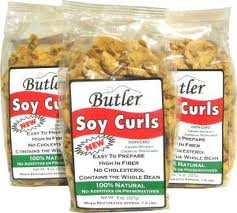
But you can get protein without the fat and a lot fewer calories when you substitute corned beef with seitan (a vegan meat substitute made from wheat gluten) or Butler's soy curls (a gluten-free, vegan meat substitute made from minimally processed soy). In fact, ounce per ounce, seitan has even more protein than corned beef!

A 3 oz serving of seitan provides:
124 calories
2.25 g total fat
0 g saturated fat
0 mg cholesterol
3 g carbohydrates
22.5 g of protein
0 fiber
A 3 oz rehydrated serving of soy curls  (1 oz dry) provides:
100 calories
4.5 g total fat
0 g saturated fat
0 mg cholesterol
5 g carbohydrates
10 g protein
3 g of fiber

Soy curls are gluten free, non-GMO and grown without pesticides

No Food Coloring in This Dish!
You'll probably be getting enough food coloring today in your beer so to make the "meat" in this recipe that reddish, corned beef color, I soaked the seitan and soy curls in beet juice and pickling spices. 


          *               *               *                 *                 *

Corned Beef and Cabbage
Vegan, Gluten Free (when made with soy curls)
[makes 4 servings]

3 medium beets, peeled and sliced (optional)
1/4 teaspoon salt plus more for potatoes
4 teaspoons pickling spice, divided
water
1 T Earth Balance vegan buttery spread
1 onion, cut in half and thinly sliced
1 carrot, peeled and sliced
1 head cabbage, cut in 8 pieces
3 to 4 cups vegetables broth (or water and bouillon cube)
4 medium, red skinned, new potatoes, quartered
4 ounces (1/2 package) Butler's soy curls OR
OR 8 ounces seitan strips or slices

If you want your "meat" to be reddish, you will be dying them in natural beet juice.
To prepare the beet juice, place the beets in a medium saucepan and cover with about 3 to 4 cups of water. Add salt, cover and cook until the beets are tender. 
Remove the beets and set aside for a little salad (see below). 

Boil beets for food coloring.
Remove beets and save the liquid.

Keep the remaining beet water in the saucepan. Add 1 tablespoon of pickling spice, (reserving 1 teaspoon for the vegetables), and simmer, covered, for 10 minutes.

Soak seitan or soy curls in the hot, spiced beet water and set aside until needed. 

Soak seitan in spiced beet juice

Or soak soy curls in spiced beet juice

Heat the Earth Balance in a 5 quart Dutch oven. Cook the onions until soft, about 5 minutes.
Stir in the carrots, cabbage and 1 teaspoon of pickling spice. Cover with 3 cups of broth and cook, covered, stirring occasionally, until the cabbage wilts, about 15 minutes. 

Cook cabbage until it wilts

Add potatoes last 

Stir in the potatoes. Sprinkle with salt and pepper to taste. If it looks like the pot needs more liquid, add another cup of water or broth.
Cover and cook until the potatoes are tender but not overcooked, about 15 to 20 minutes.

The seitan is ready to serve. Place the vegetables in a plate and top with the seitan.

Corned beef and cabbage with seitan

If using soy curls, drain them well and cook them in a slightly greased hot skillet for several minutes until they begin to brown. Serve with the vegetables.

Cook soy curls before serving

Corned beef and cabbage with soy curls

If you don't care about the color of the meat and want to make this easier:
Heat 2 to 3 cups of water and 1 tablespoon of pickling spice. 
Soak the seitan and soy curls in the hot, spiced water, omitting the beets.
Continue as stated above.

About those leftover beets. Toss with a bit of apple cider vinegar and hemp (or extra virgin olive) oil. Salt and pepper to taste and enjoy!


Serve the leftover beets as a side salad


Monday, March 11, 2013

Vegan And Gluten Free Asparagus And Shiitake Mushroom Stir Fry

A simple stir fry with fresh asparagus and shiitake mushrooms.

Follow Foods For Long Life on FACEBOOK .

Asparagus
Doug and I love asparagus whether it's raw, roasted or in a simple stir fry. This week they appeared in all of our favorite grocery stores. We've already made them twice in the past few days and have more in the refrigerator!


These lovely green spears are packed with vitamins and minerals as well as protein and dietary fiber - perfect for a low calorie, high fiber diet!


A cup of asparagus has only 27 calories 
and is a very good source of:
 protein, dietary fiber, vitamin A, C, E, K, Thiamin, Riboflavin, Niacin, B6, Folate, Iron, Phosphorus, Potassium, Copper and Manganese.

          *                      *                     *                    *

Asparagus and Shiitake Mushroom Stir Fry
Vegan, Gluten Free 
[makes 4 servings]

1 pound of fresh asparagus
1 tablespoon cornstarch
1/2 cup room temperature water
1 tablespoon freshly squeezed lemon juice
1 tablespoon gluten free soy sauce
1 tablespoon sesame oil
1 medium onion, cut in half and thinly sliced
3 cloves garlic, minced
1 tablespoon minced fresh ginger
1/4 teaspoon ground black pepper or to taste
8 ounces fresh shiitake mushrooms, stems removed, large ones cut in half
2 cups cooked brown rice or 8 ounces cooked noodles (optional) 

Bend the bottoms of the asparagus spears until they snap off. Rinse well or soak in cold water. Drain and cut into 1 1/2 inch pieces and set aside.

Stir cornstarch into the water until it is completely dissolved. Mix in the lemon juice and soy sauce. Set aside.

Heat oil in a non-stick wok or large frying pan. Cook onion for a minute stirring until separated.
Add garlic, ginger and black pepper and cook until fragrant, about a minute.

Add shiitake mushrooms and cook, stirring frequently, until they soften, about 3 minutes.

Stir in asparagus and cook until they are fork tender. 

Stir the cornstarch mixture again since some of it may have settled to the bottom. Pour into the hot wok and cook until the sauce thickens and coats the vegetables.

Serve as a side dish or over cooked brown rice.

If you are serving with either buckwheat or gluten free rice noodles, you may stir cooked and rinsed noodles into the wok when the sauce begins to thicken.  

Per serving (without rice or noodles): 93 calories, 3 g total fat, 0.5 g saturated fat, 25 mg omega-3 and 1,461 mg omega-6 fatty acids, 0 mg cholesterol, 5 g protein, 13 g carbohydrates, 4 g dietary fiber and 240 mg sodium.


Monday, March 04, 2013

Spaghetti And Tofu Stuffed Eggplant - Vegan And Gluten Free


Spaghetti makes a fun stuffing for fiber packed eggplants!

Follow Foods For Long Life on FACEBOOK .

Just for Fun!
I've been wanting to do something with eggplant lately so I decided to stuff them. Most stuffed eggplant recipes use chopped meat or breadcrumbs. I thought, "wouldn't it be fun to stuff them with spaghetti"?

Eggplant
This purple beauty is packed with fiber and is an excellent source of manganese, potassium, folate and a host of other vitamins and minerals. They do belong to the nightshade family of vegetables so some people avoid them. Being Italian, it's impossible for me to avoid nightshade vegetables which include tomatoes and peppers - how could I possibly cook without these wonderful vegetables? But some people are sensitive to the alkaloid solanine, contained in nightshades, which can aggravate joint pain in a small number of people.


Although these eggplants are organic, you can buy conventional with safety as eggplants are part of the "Clean 15" and are grown with very little pesticides.

                     *                      *                    *                    *                

Spaghetti and Tofu Stuffed Eggplant
Vegan, Gluten Free (when made with gluten free spaghetti)
Requires a large pot, a 3 quart saucepan and a 9"x13" baking dish
[makes 4 servings]

2 eggplants (1 pound each)
4 ounces whole wheat or gluten free spaghetti
1/4 teaspoon ground black pepper
1/2 teaspoon dried basil
1/4 teaspoon salt or to taste
1 tablespoon extra virgin olive oil
1 cup chopped onion
3 cloves garlic, chopped,
8 ounces firm, organic, non GMO tofu
1 tablespoon ground flax seed
2 tablespoons vegetarian nutritional yeast
1/2 cup diaya mozzarella style shreds
1 cup prepared marinara tomato sauce 

Preheat oven to 350 degrees. Lightly grease the 9"x13" baking dish and set aside.

Prepare the eggplant. With a sharp knife, score the eggplant 1/2 inch from the edge. Be careful not to penetrate the bottom of the eggplant.
With a spoon, scoop out the pulp leaving enough eggplant to provide structure.
Save 4 cups of pulp, discarding any with too many seeds.
Place hollowed out eggplant, hollow side down, in a large pot on a steamer basket. Cover and steam briefly until they begin to soften, about 3 minutes. Don't cook too long or they will lose their shape and be difficult to stuff. Carefully remove the eggplant shells and drain on a paper towel.


Score eggplant and scoop out pulp
Leave enough eggplant to provide structure
Cover and steam briefly 

Break the spaghetti in half. Using the smaller, 3 quart saucepan, prepare the spaghetti according to manufactures instructions. Cook "al dente".
Rinse and set aside.


Use your favorite spaghetti.
For gluten free, use brown rice or quinoa spaghetti.

Chop the eggplant pulp into 1/2 inch cubes and place in the 3 quart saucepan with a half cup of water, black pepper, dried basil and salt. Bring to a boil on high heat. Lower the heat, cover and simmer until eggplant softens, about 5 minutes. Remove the cover and cook until most of the moisture has evaporated.


Cook eggplant pulp until soft and dry.

Heat the olive oil in the large pot. Add the onions and cook until they soften, 5 minutes. 
Add the garlic and cook until fragrant, another minute.

Crumble the tofu and add to the onions. Cook several minutes, stirring constantly.  

Turn off the heat and stir in the ground flax and nutritional yeast until well combined. 

Add spaghetti and most of the mozzarella shreds, reserving 1 or 2 tablespoons for topping. Adjust salt and pepper if needed.


Mix all stuffing ingredients.

Place the eggplant shells in the baking dish and stuff each with 1/4th of the mixture.

Cover with marinara and sprinkle with the remaining daiya mozzarella shreds. 

Cover with foil making sure the foil does not touch the eggplant.
Bake for 25 minutes. Remove the foil and bake another 5 minutes.


Stuff and bake.

Remove from the oven and serve. Each eggplant half is one serving.


A single serving provides 15 grams of fiber!

Per serving (made with whole wheat pasta): 326 calories, 11 g of total fat, 2 g saturated fat, 568 mg omega-3 fatty acid*, 1,677 mg omega-6 fatty acid*, 0 mg cholesterol, 15 g protein, 49 g carbohydrates, 15 g dietary fiber and 624 mg sodium. 

Per serving (made with gluten free brown rice pasta): 336 calories, 12 g of total fat, 2 g saturated fat, 561 mg omega-3 fatty acid*, 1526 g omega-6 fatty acid*, 0 mg cholesterol, 13 g protein, 49 g carbohydrates, 13 g dietary fiber and 629 mg sodium.

* This does not include any contribution for omega-3 or omega-6 fatty acids from daiya mozzarella shreds, nutritional yeast or the gluten free pasta since that information was not available from the manufacturer. 


Monday, February 25, 2013

Why You Should Leave The Paleo Diet To The Caveman

You may want to pass on this fad diet!

Follow Foods For Long Life on FACEBOOK .

The Paleo Diet
I've heard quite a few people talk about the Paleo diet, many of whom are athletes. Not surprising really. Athletes are always looking for an edge and for those who want to do it naturally, eating what they consider to be "a healthy diet" is a no brainer. And cavemen certainly appear to be trim, fit and strong, carrying around those big manly clubs and hunting for their food. 

The "Paleo Diet" was originally published as a weight loss  book by Dr. Loren Cordain who subsequently targeted athletes in the book, "The Paleo Diet for Athletes". Quite simply, Dr. Cordain feels that the best diet for our general health and for optimal athletic performance is one that mimics that of our cavemen ancestors. It consists of food that can be hunted or gathered and is composed of lean, grass-fed meats, seafood, eggs, fruits, vegetables, healthy oil (such as avocado, flaxseed, etc.) , nuts and seeds. It avoids grains, legumes (including peanuts), potatoes, dairy, refined oils, salt, processed food, sugars and alcohol.

Other than the health benefits of giving up processed foods, dairy, sugar and unhealthy fats, and consuming more fruits and vegetables, there are many reasons to pass on this diet. Here are a few of them.

Eight Reasons Not To Go Paleo

#1 - Too Much Animal Protein
The suggested menus on the paleo diet website recommends meat at every meal. Diced turkey in your morning omelet, beef slices on your lunch salad and pork or fish with your veggies at dinner. This amounts to 21 meat meals per week or 19% to 35% of calories coming from meat. This compares to the 15% found in the average western diet.

Eating too much animal protein can cause a host of problems. 
* Animal protein increases the acid load in our bodies. To neutralize this acid in the blood and tissues, calcium is pulled from our bones which can lead to increased risk of bone fractures. A high protein diet can have devastating results on bone health as it literally washes the calcium out of our body.
* This causes the excessive excretion of calcium in the urine. Long term, this could lead to kidney stones and osteoporosis.
* Too much protein can put a strain on the kidneys as it tries to eliminate the wastes from protein metabolism. Although there is debate whether or not this is a problem for healthy individuals, studies show that those with reduced kidney function would experience further decline on a high protein diet.  

#2 - Too Much Saturated Fat
Although the Paleo diet recommends lean, grass-fed, pasture-raised meat, only 1% of the meat sold ever saw a grassy pasture. The other 99% were raised in factory farms and do not have the beneficial fatty acids, like conjugated linoleic acid, found in grass-fed meat. And irregardless of how "lean" the meat eaten on this diet is, 21 meat meals per week could lead to too much saturated fat and cholesterol. 

I know you athletes out there will think that this won't effect you because you  plan to "burn it off" but that attitude can take you down a slippery slope. Sometimes when we work out a lot we feel we "deserve" to eat whatever we want. In the case of the Paleo diet, that may equate to meat that's not as lean as the diet dictates. But the opposite is true. When you work out hard is when you should be providing the very best fuel for your body. So if you are eating lots of animal protein and, therefore, more saturated fat and cholesterol than you should, some of that cholesterol can end up in your arteries regardless of your workout routine.

* Excess saturated fat in a diet is a major risk factor for heart disease.
* High fat diets cause the build up of cholesterol in the arteries which could lead to stroke, cardiovascular and coronary heart  disease. 
* The Dietary Guidelines for Americans recommends limiting saturated fat to no more than 10% of total daily calories and 7% to further reduce risk of heart disease.

#3 - The Diet Avoids One of Nature's Best Foods - Legumes
Beans are one of the healthiest foods you can serve your family. Not to mention a life without hummus, bean chili, and a salad topped with garbanzos is unimaginable!

* Beans are an economical source of high quality protein that provides essential amino acid building blocks without the saturated fat and cholesterol contained in meat. 
* They are one of the most concentrated natural sources of the B vitamin folate and are rich in thiamin. Beans contain minerals such as potassium, zinc, iron, copper, phosphorous, manganese, and magnesium.
* High in antioxidants, a half cup of dried small red beans has more antioxidant capacity than a cup of wild blueberries. 
* Beans are a excellent source of dietary fiber.
* The Nurses' Health Study II linked the consumption of beans to a lower risk of breast cancer. 
* Soybeans, made into tofu, is an excellent source of calcium.  One half cup of calcium set tofu delivers nearly 900 mg.

Legumes

#4 - A Diet Without Whole Grains - Really?
The Paleo diet avoids healthy grains such as brown rice, quinoa, 100% whole wheat, whole oats/oatmeal, barley, rye, buckwheat, cracked wheat (bulgur), popcorn, millet and sorghum.  These are important foods and can contribute greatly to good health.

* Whole grains provide healthy, complex carbohydrates. Carbohydrates are broken down into simple sugar during digestion and the resulting glucose is used as your body's main source of fuel (remember the good old days when we runners carbo loaded before that big race!).
* The 2010 Dietary Guidelines for Americans recommends that carbohydrates make up 45 to 65 percent of our daily calorie intake. This is extremely difficult to do without the consumption of  grains (and beans).
* Whole grains contain protein, fiber and antioxidants.
* They are rich in B vitamins and minerals such as iron, zinc, copper and magnesium. 
* The consumption of whole grains has been shown to reduce the risk of heart disease, type 2 diabetes, obesity and some cancers. 
* Whole grains promote the growth of healthy bacteria in the colon which promotes bowel health.

Whole Grains

#5 - Not Enough Fiber
The Paleo diet brags about providing lots of fiber because it includes fruit and vegetables. However, without beans and whole grains it is very difficult to achieve a minimum of 25 to 35 grams per day, especially when 35% of the calories come from meat which contains zero fiber. 
For example, on the Paleo diet, even if you ate 1 cup of strawberries at breakfast, an apple for a snack, a cup of coleslaw at lunch, 3 cups of salad and a cup of cooked spinach at dinner (as an accompaniment to all the meat contained in each of your three meals), you would barely get 15 grams of fiber. A single cup of lentils, forbidden on the Paleo diet, provides almost 16 grams!

A healthy diet must have adequate fiber.
* Fiber is critical in bowel health. Insufficient fiber can lead to constipation, hemorrhoids, and diverticular disease.
* A diet high in fiber helps control and stabilize blood sugar. This is particular important with people at risk for type 2 diabetes.
* High fiber foods help you feel full longer and help control weight gain.
* Soluble fiber, like that found in beans or oats, can help lower cholesterol.
* High consumption of dietary fiber has been linked to lower risk of heart disease and colon cancer. 

#6 - The Paleo Diet is Very Expensive 
Grass fed meat is very costly. Let's be realistic. How many people on this diet would be willing to spend $26 a pound for a grass-fed steak? Do you think most restaurants are going to? As I already mentioned, only 1 percent of the meat sold is raised on a pasture. The rest is factory farmed. So what does this mean?

* It means that most of your meat meals, especially those eaten in a restaurant, will most likely be from factory-farmed sources.
* Non-pasture raised meats are not as lean and contain more saturated fat. 
* Non-pasture raised meats may also contain growth hormones, antibiotics and toxic pesticides.

#7 - And What About the Planet
Having the world convert to a diet with 21 meat meals per week is environmentally unsustainable.

* Animal agriculture is already considered the greatest contributor to global warming and produces more greenhouse gas emissions that all of the planes, trains, ships and automobiles in the world combined. 
* Animal agriculture utilizes an enormous amount of the earth's land and water for pasture and growing feed for animals. It also drives deforestation for additional pasture land.


What about the planet?

#8  - You Don't Have To
Perhaps the biggest reason to not go on the Paleo Diet is because you don't have to. Believe me, if there were a Whole Foods available during the Paleolithic period, that cave man would certainly not have chosen this restrictive diet. In fact, if he were to beam himself down right now and saw people purposely avoiding delicious grains, beans and yummy baked sweet potatoes, he'd be scratching his head in wonder. 


Monday, February 18, 2013

Vegan Cauliflower And Peas On Barilla's White Fiber Mini Shells - Enjoy The Taste Of White Pasta With The Fiber Of Whole Wheat!

As delicious as white pasta with 6 g of fiber per serving!

Follow Foods For Long Life on FACEBOOK .

New and Exciting Products from Barilla!
Getting sufficient dietary fiber in your diet is one of the most important things you can do for your health. For pasta lovers this means having to forgo the comforting taste and texture of semolina or "white" pasta when they opt for higher fiber, whole grain pasta. This is where even my most health conscious friends and family draw the line. 

But I recently discovered a new product from Barilla that looks, cooks, chews and tastes just like regular white pasta but has 6 grams of fiber per 2 ounce serving - the same amount that you would get from whole grain pasta. 


A 2 oz serving of "white fiber" mini shells has:
200 calories
1 g fat/ 0 saturated fat
0 cholesterol

43 g carbohydrates
6 g dietary fiber
6 g protein

The ingredients listed for this new pasta are: 
Semolina wheat (sorry, these are not gluten free), durum wheat flour, whole durum wheat flour, and corn starch. The fiber comes from the whole durum wheat flour and the "hi-maize 260" (which is listed as corn starch). 
Hi-maize resistant starch is made from corn that has been hybridized through a natural plant breeding program.  It does not contain genetically modified material. After harvesting, the corn is milled and dried to a fine, cornstarch powder. This powder contains a "resistant starch" that resists digestion in the small intestine and behaves as dietary fiber in the large intestine.  

White fiber pasta comes in three shapes:
Mini Shells
Mini Penne
Mini Rotini

This pasta has a great taste and texture and besides the mini shells, it comes in mini penne and mini rotini. I wish it came in some other shapes and sizes - let's hope they are working on that right now!

Here's a delicious and simple recipe that's under 300 calories per serving, provides 10 grams of protein and around one third of your daily requirement of dietary fiber.

              *            *            *           *           *

Cauliflower and Peas with Mini Shells
Vegan
[makes 4 servings]
Requires a large pot to cook the pasta and a large saucepan with a cover 

2 tablespoons extra virgin olive oil (divided)
3 cloves garlic, minced
1/8 to 1/4 teaspoon red pepper flakes*
1 small head cauliflower, cleaned and cut into very small florets
15 ounce can organic peas with juice
1 cup water
1 vegan bullion cube
1 teaspoon dried parsley flakes 
6 ounces (1/2 box) Barilla white fiber mini shells
* for less spice, you may omit red pepper flakes or substitute ground black pepper

Fill a large pot with water and salt for the pasta and bring to a boil.

Meanwhile, make the sauce. Heat 1 tablespoon of the olive oil in a large saucepan. Add garlic and red pepper flakes and cook on medium low heat until garlic is fragrant and slightly brown, 1 to 2 minutes.


Always let minced garlic sit for 15 minutes before cooking to help it maintain its beneficial properties.


Cut the cauliflower into very small florets so that is cooks quickly.

Stir in the cauliflower florets to coat and add the juice from the can of peas, water, the bullion cube, the dried parsley flakes and the remaining tablespoon of olive oil. Stir to combine. Bring to a boil on high heat. Lower the heat, and stir until the bullion cube dissolves. Simmer, covered, until the cauliflower begins to soften, about 6 to 8 minutes.


Cover and simmer until cauliflower begins to soften.

While the cauliflower is cooking, prepare the pasta according to directions. Drain and set aside.

When the cauliflower begins to soften, stir in the peas and cook, covered, until the cauliflower is tender, about 5 minutes. Add salt to taste.


Stir in peas, cover and simmer.

Stir in the cooked shells and serve immediately. 


Add the cooked shells and serve.

Per serving: 299 calories, 8.5 g total fat, 1 g saturated fat, 115 mg omega-3 and 788 mg omega-6 fatty acids*, 0 mg cholesterol, 10 g protein, 49 g carbohydrates, 10.5 g dietary fiber and 546 mg sodium (not including salt added to taste).
* Omega-3 and omega-6 fatty acids do not include any contribution from the pasta since that information was not available from the manufacturer.