Showing posts with label ARUGULA. Show all posts

Monday, June 03, 2013

Fresh Corn Salad With Baby Arugula And Red Onions

Fresh corn gives this raw salad a delicious crunch!

Follow Foods For Long Life on FACEBOOK .

Fresh Corn
Corn is abundant at the market right now. You can get lots of conventionally grown corn for a very low price and since it's part of the Environmental Working Group's Clean 15, it's safe from a pesticide perspective. However, if you are concerned about eating GMO foods, you may want to consider paying a bit extra for organic. 

I love corn, either raw off the cob or in a salad like this. Today I was inspired by a dish I saw in the deli case at Whole Foods.  It's a simple mixture of fresh corn with baby arugula and red onion with a lemon and oil dressing. When I compared the nutritional value of salad greens last September, arugula was high on the list so I always love using baby arugula in my salads. And, of course, I love its spicy flavor.

And remember my tip on cutting corn. Snap it in half, lay it down on its side, and cut the corn off horizontally instead of vertically. This will keep it from flying all over your kitchen!

       *                   *                     *                     *

Fresh Corn Salad with Baby Arugula and Red Onion
Raw Vegan, Gluten Free
[makes 4 servings]

For the salad
2 ears of corn
2 to 3 large handfuls of baby arugula (about 3 ounces)
1/2 cup thinly sliced red onion

For the dressing
1 tablespoon freshly squeezed lemon juice
1 tablespoon extra virgin olive oil or cold-pressed hemp oil (I prefer a mixture of both)
1/4 teaspoon salt (or to taste)

Clean corn and remove the kernels. Place in a large salad bowl with arugula and onions.

Make the dressing: Whisk oil, lemon juice and salt together until well combined.

Add dressing to the salad and toss until well coated.

Serve immediately.

Per serving: 103 calories, 4 g total fat, 0.5 g saturated fat, 311 mg omega-3 and 1,581 g omega-6 fatty acids, 0 mg cholesterol, 3 g protein, 16 g carbohydrates, 2.5 g dietary fiber and 162 mg sodium.

Thursday, October 04, 2012

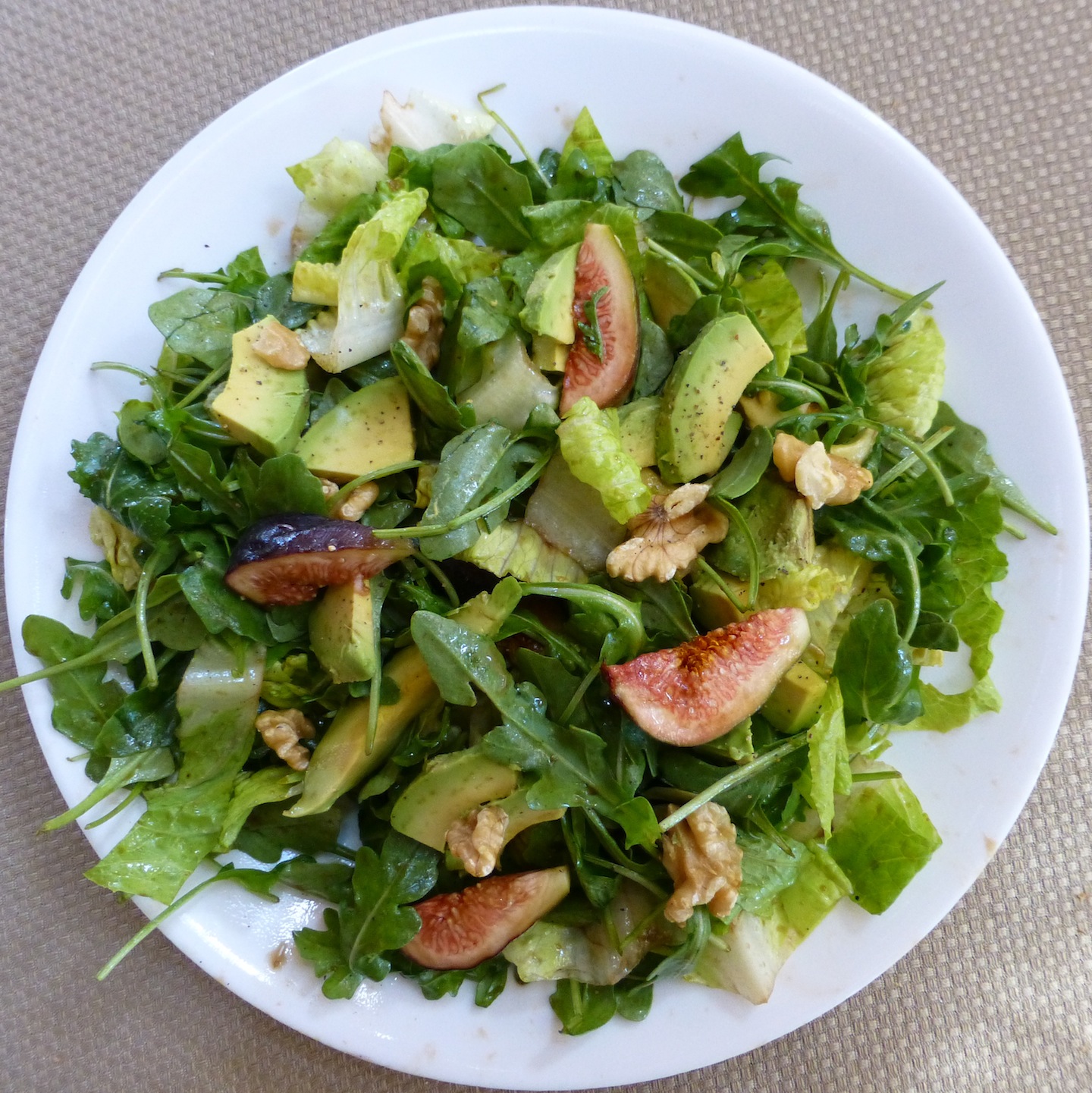
Fresh Figs With Arugula And Romaine - Raw Vegan And Gluten Free

This delicious raw salad uses very nutritious greens.

Follow Foods For Long Life on FACEBOOK .

Figs, Finally!
My friend and neighbor has the most wonderful fig tree. By the end of the summer we are usually swimming in big, juicy figs. This summer, for some reason, they never came. But yesterday, after much anticipation, I received a big bowl of this delicious fruit! If you are lucky enough to have access to local, fresh figs, here's a lovely salad to make with them.

You many remember my article on selecting salad greens that showed how arugula and romaine lettuce were among the most nutritious of all salad greens. This salad uses a combination of both.

Fresh Figs with Arugula and Romaine Lettuce
Raw Vegan, Gluten Free
[4 servings or 2 large entree-size servings]

For the salad dressing
1 tablespoon extra virgin olive oil
1 1/2 tablespoons balsamic vinegar
1 teaspoon freshly squeezed lemon juice
1 tablespoon raw honey or agave nectar *
1/4 teaspoon salt


For the salad
4 ounces baby arugula (4 handfuls)
Small head, hearts of romaine lettuce (8 ounces)
2 large fresh figs, cut vertically into 8 wedges
1/2 avocado, peeled, pitted and sliced
1/4 cup raw English walnuts
Freshly ground black pepper


* I think the honey in this recipe tastes better than the agave nectar but for vegans who avoid honey, you can make it with agave.

Make the salad dressing by combining all the dressing ingredients in a small bowl and whisking until they are well combined.

To make the salad, clean the greens and chop the romaine lettuce into bite-size pieces. 

Place the arugula, romaine lettuce and fig wedges in a large bowl. Add the desired amount of salad dressing and toss until well coated.

Divide the salad onto 2 to 4 plates. Top with the avocado slices and walnuts. Top with freshly ground black pepper, if desired, and serve.

Per serving (4 servings): 168 calories, 11 g fat, 1 g saturated fat, 819 mg omega-3 and 3511 mg omega-6 fatty acids, 3 g protein, 24 g carbohydrates, 4 g dietary fiber and 161 mg sodium.

Tuesday, September 18, 2012

Before You Reach For The Iceberg Lettuce - Select The Best Greens For Your Salad!

 Iceberg lettuce is crisp and delicious but not a nutritional star.

Follow Foods For Long LIfe on FACEBOOK .

Salad Greens
When I was a kid, we ate a salad with every meal. It was always the same - iceberg lettuce, tomatoes, vinegar and oil. There really wasn't much choice of salad greens in the super market back then. Today, of course, you can walk down an entire isle of salad green options - besides iceberg you may find romaine, butter lettuce, red leaf, green leaf, arugula, spinach and so on. And many are offered both organically or conventionally grown! So how are we to choose?

Taste preference is always a major factor. Arugula or rocket, has a slightly bittier or peppery taste. Lettuce has a more subtle flavor and often takes on the flavor of the salad dressing. Salad greens are also selected for their distinct textures. Romaine is crunchy while butter lettuce (also known as Boston or bibb lettuce), red leaf and green leaf have a more delicate texture. Salad greens also vary in their nutritional content.

Nutritional Comparison of Salad Greens
All salad greens are very low in calories (less than 10 calories per ounce), and have no saturated fat or cholesterol. They are also extremely low in sodium. Although they may not seem to be contain high amounts of vitamins and minerals, on a per calorie basis, they are very nutrient dense.  Here's how these salad greens differ in several beneficial nutrients:

Vitamin A
This fat-soluble, antioxidant vitamin is important for vision, growth and development, healthy skin and a strong immune system. If you have night blindness, dry skin or just want to boost up your immunity and want a salad green with the highest amount of vitamin A, your best choice would be romaine or spinach - just two ounces would provide your entire daily requirement. Red and green leaf lettuces are also a very good choice. Iceberg on the other hand only provides 3% of your daily requirement per ounce.

One ounce of Romaine lettuce is only 5 calories and provides:

2439 IU vitamin A
7 mg vitamin C
29 mcg vitamin K
38 mcg folate
9 mg calcium

Vitamin C
Vitamin C is also an antioxidant and supports a healthy immune system, teeth and gum health and the formation of collagen (that's what keeps our skin from sagging ladies!). It also enhances the absorption of iron. If you bruise easily or have other signs of capillary weakness, once again romaine and spinach are the best choices for their vitamin C content - two ounces provides about one quarter of your daily requirement. Since vitamin C is very heat sensitive, eating a big raw salad is a good way to get it. Make sure and include a sliced, raw, red bell pepper - one of the best sources of this vitamin (1 cup of sliced red bell pepper provides twice your daily requirement!)  

Butter lettuce is only 4 calories per ounce and provides:

927 IU vitamin A
only 1 mg vitamin C
29 mcg vitamin K
20 mcg folate
10 mg calcium

Vitamin K
Although most people aren't deficient in this important vitamin, some people are - like those suffering from Crohn's or other diseases that effect absorption in the digestive tract or those taking certain drugs that interfere with it. This fat-soluble vitamin is essential for the regulation of blood clotting and is also very important for bone health. Spinach has a high concentration of vitamin K (135 mcg/ounce), 1 ounce providing more than the daily requirement for a man (120 mcg/day) or a woman (90 mcg/day). Those of you on warfarin (Coumadin), a blood-thinning medication, may want to avoid foods this high in vitamin K. If that's the case, the other lettuces are better choices than spinach.

One ounce of Red Leaf lettuce has only 5 calories and provides:
2098 IU vitamin A
only 1 mg vitamin C
39 mcg vitamin K
10 mcg folate
9 mg calcium
Although red leaf lettuce, with its deep colors, looks more nutritious, green leaf lettuce is higher in vitamins C & K, folate, calcium and potassium. 
One ounce of Green Leaf lettuce has only 5 calories and provides:
2073 IU vitamin A
5 mg vitamin C
49 mcg vitamin K
11 mcg folate
10 mg calcium

Folate
Folate plays a key role in amino acid metabolism and DNA synthesis. It is essential during pregnancy in preventing neural tube defects. If it's folate that you are after, spinach is a good choice with each ounce providing 14% of the daily requirement with romaine coming in a close second (one ounce providing 10%). 

It's important to note that folate can mask vitamin B12 deficiency so raw food vegans, who eat lots of high folate foods and little or no B12-rich foods, can be B12 deficient for a dangerously long time without noticing it.

Arugula, or Rocket,  is 7 calories per ounce and provides:

664 IU vitamin A
4 mg vitamin C
30 mcg vitamin K
27 mcg folate
45 mg calcium

Calcium
Calcium is the most abundant mineral in the body. It is important for bone and tooth development as well as muscle contraction and nerve transmission. Although salad greens aren't a huge source of calcium, the salad green with the most calcium is arugula. A 4 ounce arugula salad provides 180 mg of calcium. More important, it's an alkaline food which doesn't draw calcium from the body like dairy sources which are acidic and cause the body to draw calcium from your bones for neutralization.
Although spinach is fairy high in calcium, it is also high in oxalates which reduce the absorption and retention of this critical mineral. To reduce the oxalic content, it's best to eat spinach cooked.

Spinach is 6 calories per ounce and provides:
2625 IU vitamin A
8 mg vitamin C
135 mcg vitamin K
54 mcg folate
28 mg calcium

So How Does Iceberg Lettuce Stack Up?
This old favorite isn't completely devoid of all nutrients - it's just not nearly as high as others. 
It contains only 1/17th the vitamin A as romaine, 1/8th the vitamin C as spinach, 1/14th the vitamin K as green leaf lettuce, and 1/11th the calcium as arugula .

Iceberg lettuce is 4 calories per ounce and provides only:
141 IU vitamin A
1 mg vitamin C
7 mcg vitamin K
8 mcg folate
5 mg calcium

How they rank
Of course their ranking depends on the nutrient you are the most deficient in - but overall, for a raw salad, romaine and arugula are the best nutritionally.
Red and green leaf are next in line followed by butter leaf.
Although spinach is an excellent source of many key vitamins and minerals, it's better prepared cooked to lessened the effect of calcium robbing oxalates.
As you may have guessed, iceberg comes in dead last. 


Tuesday, July 24, 2012

Celebrate Peach Season With Baby Arugula And Peach Salad - Raw, Vegan And Gluten Free!

Arugula and peach salad with slivered almonds.

Follow Foods For Long Life on FACEBOOK .

Peaches are in Season
On Sunday you could find peaches at almost every stand at the local farmer's market. In Sonoma county, everyone waits for Dry Creek peaches. Last year, while in Colorado, I was introduced to the wonderful Palisades peach. No matter what peach you have access to in your local area, they are a welcome sight when they finally arrive! And they pair beautifully with arugula in this quick and easy salad.


Arugula - A Nutritious Green!
Arugula, also known as rocket, has a peppery and slightly bitter flavor. Some people are put off by the bitterness of arugula while others are drawn to it for that very reason. If you haven't acquired a taste for bitter greens quite yet, try mixing them in with spring greens. I must admit, I wasn't always an arugula fan but now I love the taste, especially of delicate baby arugula.


Arugula is packed with nutrients. It's a very good source of vitamin A, C, K, folate, calcium, iron and potassium. It even provides some omega-3 fatty acid!  A two ounce serving of arugula is only 14 calories yet it provides:


1328 IU vitamin A 
8.4 mg vitamin C
61 mcg vitamin K 
54 mcg folate 
90 mg calcium 
206 mg potassium 
.8 mg iron
95 mg omega-3 fatty acid


Arugula and Fresh Peaches
I got the idea of pairing arugula and peaches from a recent recipe in the Press Democrat. Sadly, like so much of the rich food in wine country, they felt compelled to mask the beautiful, natural flavor of these 2 ingredients with prosciutto and goat cheese. I know some of you are saying, "yummm, prosciutto and goat cheese". Well, if those are your favorite food groups - go for it. But here's a light and healthy version of this recipe that I think you'll enjoy. 


Baby Arugula and Peach Salad
Raw Vegan, Gluten Free
[makes 4 servings]


2 small peaches, pitted, peeled and sliced
1 tablespoon freshly squeezed lemon juice
8 ounces baby arugula, cleaned
1 tablespoon plus 1 teaspoon cold pressed hemp oil or extra virgin olive oil
salt to taste
2 tablespoon slivered almonds (or raw pecans or walnuts)


Place peeled peaches in a small bowl and toss with lemon juice. Set aside.
Place arugula in a salad bowl and toss with oil and salt until nicely coated. Transfer to 4 plates.
Divide and mound peaches over arugula along with remaining juices. 
Top with nuts and serve.


Per serving (using hemp oil): 103 calories, 6.9 g fat, 0.6 g saturated fat, 863 mg omega-3 and 3368 mg omega-6 fatty acid, 0 mg cholesterol, 2.7 g protein, 23.5 g carbohydrates, 2.2 g fiber and 39 mg sodium (plus sodium from added salt). 


This recipe is appropriate for use during a raw food cleanse.

Monday, May 23, 2011

Arugula Sprouts - Makes A Spicy Topping For Almost Anything! A Recipe For Raw D'Oeuvres

Serve this tasty Raw D'oeuvre at your next party!

Follow Foods For Long Life on FACEBOOK !


My Latest Find
I was preparing to do a photo shoot for my new cookbook last week and was looking for something beautiful to top a raw pizza. While in Whole Foods, I found these adorable arugula sprouts! Not only are they beautiful, their intense spicy flavor makes them a perfect topping for so many dishes, cooked or raw! Top a salad, a raw or cooked veggie pizza or hor d'oeuvres. Put them in a sandwich or over pasta, gnocchi or a baked potato. They will taste as though you just topped the dish with freshly ground black pepper!


Arugula sprouts
Spicy, fresh, crisp and packed with nutrients!


Intense in Flavor and Nutrition
When a seed starts to sprout, it contains an intense amount of energy. Rich in enzymes, vitamin C and other nutrients, it has the vitality to begin its new life! Arugula is very good source of vitamins A, C and K as well as folate, calcium, magnesium, potassium and manganese. It even contains omega 3 fatty acid! If you can't find them in the stores, try growing them.


Raw D'oeuvres
To make raw vegan hor d'oeuves, make your favorite raw cracker. Here I used the recipe for my Sprouted lentil crust only I cut it in half because it makes a lot. Instead of making larger pizza crusts, I make smaller round crackers. You can also use the recipe for Raw Veggie-Seed Crackers. If you don't want to bother dehydrating crackers, use slices of cucumber or zucchini.
Make cashew ricotta, also from the raw pizza recipe (cut this one in half also). 
Now that you have the cracker and the "cheese", pick a topping like:
* thinly sliced kalamata olives
* chopped bell pepper
* sliced cherry tomato
* a few capers
* shredded carrot
* sliced green onion
* pesto
* fresh kernels of corn
* dried raisins or cranberries


And of course, top with some beautiful arugula sprouts!


Monday, September 27, 2010

A Simple Arugula Salad with Balsamic Chive Vinaigrette


Arugula
My daughter loves arugula so it was no surprise to find a good portion of her fall garden packed full of it. During our visit she made us a simple and delicious arugula salad dressed with a lovely balsamic vinaigrette with chives, also from her garden. When dressing arugula, she uses a 2 to 1 ratio of extra virgin olive oil to aged balsamic. When dressing a regular salad, she prefers a 1 to 1 ratio.
Arugula is a leafy green, cruciferous vegetable that contains anti-cancer compounds called glucosinolates. These compounds have strong antioxidant properties and also stimulate the body to produce detoxifying enzymes.
Arugula is an excellent source of vitamins A, C and K as well as folate, calcium, manganese, potassium and magnesium. It is also a very good source of iron, phosphorus, and riboflavin.
There are only 5 calories in each cup of arugula so you can enjoy as much as you like. If it is too bitter to eat by itself, mix it with lettuce. But the bitterness in arugula also has beneficial properties as bitter foods can stimulate appetite and increase the flow of digestive juices.

* * *

Balsamic Chive Salad Dressing For Arugula
[makes 6 1/2 tablespoons]
1 tablespoon young chives, snipped or finely sliced
2 tablespoons aged balsamic vinegar
1/4 cup extra virgin olive oil
salt and freshly ground black pepper to taste

Mix together well and use as needed to dress an arugula salad.

Per tablespoon of dressing: 78.2 calories, 8.3 g fat, 1.2 g saturated fat, 0 mg cholesterol, 3.0 g protein, 4.0 g carbohydrates and 2 g of fiber.