Showing posts with label DEHYDRATOR. Show all posts

Friday, November 30, 2018

Dehydrate Your Persimmons For Winter Storage

Dried persimmons make a great snack.

Follow Foods For Long Life on Facebook and Pinterest.
Fuju Persimmons
We have two Fuju persimmon trees and this year both of them really produced. The thing I love about Fuju persimmons is that you can eat them firm, like an apple or pear. They aren't as good when they get too soft so when that happens, I dehydrate them. Dried persimmons make a wonderful snack.

You can see that we had way too many to eat.
And this is after  we gave lots of them away!
Dehydrating Persimmons
I like to peel mine but many people leave the skin on.
Place the peeled and sliced persimmons on the non-stick teflon dehydrator sheets. If you leave the skin on, you can just cut them horizontally in circles. I like mine peeled and cut into thin wedges as seen in the picture below.


Spread the persimmons on your dehydrator's teflon sheets on the trays. 
Place the trays in your dehydrator. 
We have a 5-tray Excalibur Dehydrator which we really like.


Dehydrating temperature will depend on what's important to you. If you want them to be "raw", and retain their living enzymes, you can dehydrate them at 115 degrees F. This will take 24 hours. You can cut the time if you raise the temperature to 125 or higher.

Dry at 115 to 125 until they are somewhat dry on top and start to pull up from the teflon sheets (about 10 hours). At that point, turn them over, remove the teflon sheets and place the persimmons directly on the mesh sheets. Dry another 10 to 12 hours until they are dry but still a bit pliable. 
Remove when dry but still a bit pliable.

Store in an airtight container.
Serve with an assortment of nuts when guests come. Or put this nut/fruit assortment in your kid's lunchbox or take to work as a midday snack!

A healthy snack.


Wednesday, October 26, 2016

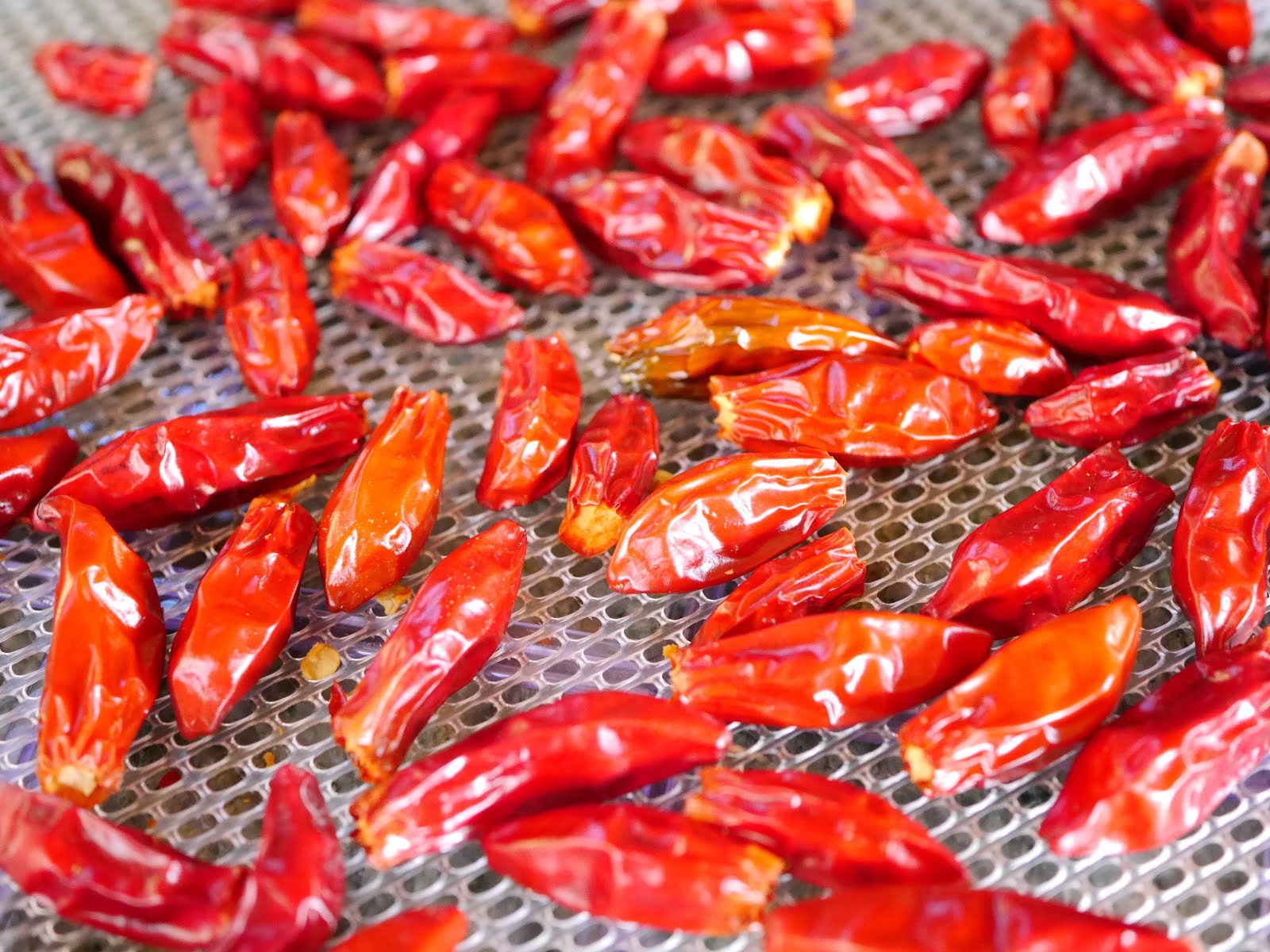
Dehydrating Serrano (Hidalgo) Peppers

Dried Serrano peppers will spice up your winter recipes!

Follow Foods For Long Life on Facebook and Pinterest.
Preview my eBook, Health Begins in the Kitchen.

End of Season Harvests
I'm just wrapping up the summer gardening season. The peppers and eggplant are done producing, the rains are coming, and in about a week, I'll finally be finished canning, freezing and dehydrating - hooray! 

I grew a single Serrano pepper plant and while it was growing, I only pulled a few green peppers from it to cook with. So by the time it was ready to harvest, it had almost two pounds of beautiful ripe, red peppers varying in size from one to two inches. 


This is probably a life-time's worth of Serrano peppers, but I will dehydrate all of them and give them to whomever wants to spice up their life a bit! Last year I used them to make a lot of hot sauce, some of which I still have. It lasts a very long time in the refrigerator! Here's a recipe for Hot Sauce using Jalapeños and Serrano Peppers

Serrano peppers, also known as Hidalgo peppers, are spicier than jalapeños but not as spicy as habaneros. To find out how hot your favorite pepper is, check out this Pepper Scale.

Dehydrators
I have enjoyed my Excalibur Dehydrator. When I first bought it, I wondered if I'd ever use it, but I use it all the time. Besides drying fruit and vegetables, I use it to make crackers, fruit leather, and other things. There are many other brands on the market that vary in size and price so pick one that suits your needs.


Dehydrating Serrano Peppers
Place the peppers in a colander and wash them well. Wrap them in a kitchen towel and dry completely.

Wash in a colander

Wearing plastic gloves, cut the tops off of each pepper. I sliced the larger serranos in half and left the smaller ones whole but if I had to do it over, I would slice them all as it took two days to dry the whole ones. 

Place them on the woven dehydrator sheets without the non-stick solid teflon sheets so that the peppers get maximum air flow. Place the sliced peppers with the seeds facing up so they don't all fall out in your dehydrator.

Sliced peppers

Whole peppers

Put the dehydrator in a well ventilated room and open the window so the fumes don't get overwhelming. 

Place the sheets in the dehydrator and set the temperature to 125 to 135 degrees.  The sliced ones will be ready in about 10 hours but may take longer. The whole peppers may take a day or more. Make sure they are fully dried so they will not mold when storing.

Dried, sliced peppers

Put the dried peppers in glass jars and store in a cool, dry place.


To cook with the dried peppers, crumble them soups or stir fries. To make cayenne-like pepper, you can grind the dried peppers in a spice grinder and sprinkle on food. However you use these spicy little guys, they can boost your metabolism and help you burn more calories!


Friday, October 26, 2012

Pick And Dehydrate Jalapeños Before Winter

Dehydrate your jalapeños and use for cooking this winter.

Follow Foods For Long Life on FACEBOOK .

Time to Pull Up the Summer Plants
I was sad to pull up my zucchini last week and now I'm getting ready to pick the last of my jalapeños. Since there are just so many jalapeños you can pop in your mouth, you may want to save them for cooking this winter. It just takes a few slices of dried jalapeños to spice up that chili or to make a spicy, Italian "fra diavolo" tomato sauce. So before it gets too cold, I picked a bunch of my precious peppers and dehydrated them.

My jalapeño plant

Take Some Precautions
When you slice your jalapeños, they will give off fumes that can be quite caustic.  As a precaution, I wear a mask. You should also be very careful not to touch the cut pepper slices or seeds. You will undoubtedly forget that you did until you go to rub your eyes - ouch!

I wear a mask when cutting jalapeños.
You can also tie a 
handkerchief or bandana across your face.

How to Dehydrate your Jalapeños
First, wash and dry your peppers.

Put on your mask (or at least tie a bandana across your face).
Holding the stem, being very careful not to touch the pepper, cut the jalapeños into thin, 1/8th inch slices. They can be a bit thicker but will take longer to dehydrate.

Hold on to the stem so that you don't touch the pepper.
You can also wear rubber gloves.

Pour the sliced peppers onto a non-stick dehydrator sheet.
Spread out, using a fork, so they have room and will dry evenly.

Spread out so they dry evenly.

Dehydrate at 115 degrees F to maintain more of their vitamins and phytochemicals. It will take about 6 to 8 hours (or longer depending on how thick they were cut) until they are nice and dry. 

Dried jalapeño slices

Once they are dehydrated, place them in a jar and store. I like to keep them as slices but you can certainly grind them into a powder that is similar to cayenne.

Jar of sliced jalapeños

Store in a cool place. Throw a few slices in any dish that needs a little zip. They will rehydrate as they cook. 

Capsaicin
Capsaicin is the compound that makes jalapeños hot. It is also the compound that has many health benefits such as relieving congestion, fighting inflammation, helping you burn fat by stepping up your metabolism and more. To read more about jalapeños, check out Jalapeño Madness. 


Monday, August 13, 2012

Crispy Raw Vegan And Gluten Free Zucchini Onion Crackers - High In Omega-3 Fatty Acid

Zucchini and onion crackers packed with omega-3.

Follow Foods For Long Life on FACEBOOK .

It's Zucchini Season
About this time each year I search for ways to use up my zucchini. This crispy cracker does the trick! Besides using 2 1/2 pounds of zucchini per batch, these delicious gluten-free crackers deliver 626 mg of omega-3 fatty acid per cracker! Here's how to make them.

Zucchini Onion Crackers
Raw Vegan, Gluten Free
[makes 40 crackers]
Requires a Dehydrator & a tool to grind walnuts

2 1/2 pounds zucchini
1 small onion (6 ounce)
3/4 cups ground flaxseeds
1/2 cup ground English walnuts
2 tablespoons gluten free tamari soy sauce
2 tablespoons freshly squeezed lemon juice

Grate the zucchini on a large grate. You should have about 7 1/2 cups of shredded zucchini.


Grate the zucchini using the medium grates.

Cut the onion in half or quarters and thinly slice. 

Slice the onion as thinly as possible.

Place the zucchini and onions in a large bowl.

If you are grinding your own flaxseeds, start with 1/2 cup of whole flaxseeds to yield the needed 3/4 cups of ground flaxseeds. 

Grind the walnuts in a Vitamix, food processor or coffee grinder (reserved for nuts and seeds). You will need 1/2 cup of walnut pieces to yield the needed 1/2 cup of ground walnuts.

Add the ground flaxseeds and walnuts to the bowl of zucchini and onion.
Add the soy sauce and lemon juice to the zucchini onion mixture. 
Mix thoroughly until well blended.


Mix all ingredients thoroughly.

Divide the mixture between two 14" x 14" inch non-stick dehydrator sheets. 
Spread it out into 11" x 11" squares. The mixture will look thick but it will thin out significantly after dehydrating.

Spread mixture on to 2 dehydrator sheets.

Dehydrate for 24 hours at 115 degrees F. 

After dehydrating, the mixture will thin significantly.

After 24 hours, flip over onto mesh dehydrator sheets. Slowly peel off the non-stick dehydrator sheets.
Place back in the dehydrator for another 6 to 10 hours.

Peel off the non-stick dehydrator sheets slowly.

Place on a cutting board and cut into crackers with a pizza cutter or sharp knife.
Cut one side into 4 equal pieces and the other side into 5 equal pieces. Each sheet will yield 20 crackers.


Cut into desired cracker sizes.

If  the crackers are not crisp enough, place individual crackers on the mesh sheet and dehydrate until they reach the desired crispness. (If they still bend, they are not crisp enough).

Dehydrate until crisp.

Store in an air tight container and refrigerate.


Serve with soup, along with dips, or just enjoy as is!


Per cracker: 26.1 calories, 2 g fat, 0.2 g saturated fat, 625 mg omega-3 and 690 mg omega-6 fatty acids, 0 mg cholesterol, 1 g protein, 2 g carbohydrates, 1 g dietary fiber and 52.5 mg sodium.

Saturday, February 13, 2010

My Garlic Is Sprouting! What Should I do? How To Make Your Own Garlic Powder.

Garlic begins to sprout when it gets too cold.

Remove the sprout from the garlic clove before slicing.

Sliced garlic on a Teflex sheet ready to dehydrate.

Dried garlic chips in a VitaMix "dry" container.
Sift to separate dried minced garlic from garlic powder.

Sifted garlic powder.

Dried garlic chips, minced garlic and garlic powder.


My Garlic is Sprouting!
My husband and I went on vacation and to save energy, we shut off the furnace. We live in California so we weren't too worried about our pipes freezing. But what we forgot was that garlic starts to sprout when it gets too cold. We had our 200 heads of garlic that we harvested this spring in the house and we were unpleasantly surprised to find about 1/3 of them sprouting when we got home. I had already planted all the garlic that I needed for next season and it was a bit too late to prepare another bed anyway. What on earth was I going to do with all of this sprouting garlic?

When Life Hands You Lemons.....
What's that old expression? When life hands you lemons, make lemonade. So, when life hands you sprouting garlic, why not make garlic powder? I've always wanted to try making my own garlic powder. It always annoyed me to grow hundreds of heads of garlic and then go buy a jar of garlic powder. But I never wanted to waste a beautiful, fresh head of garlic to do this. Finally, here was my chance!

How to Dry and Process Garlic
1. Break the garlic heads into individual cloves
2. Remove the skin, cut off the bottom root area and slice the clove in half vertically, exposing the green sprout.
3. Remove the green sprout intact and slice the remaining garlic into 1/4 inch slices.
4. Place slices on a Teflex sheet and dehydrate at 105 degrees F until crisp.
5. Fill the bottom of a blender about 2 inches with dehydrated garlic slices. I used a VitaMix "dry" container but I believe any good blender will work.
6. Process in the blender until you have the desired consistency. If you want some "minced" garlic granules, stop before everything is processed into powder.
7. Sift the contents of the blender through a strainer. The sifted garlic can be used for garlic powder and what you catch in the strainer can be used as larger granulated or minced garlic.
8. To make garlic salt, mix the garlic powder with fine salt in a ratio of one part garlic to 4 parts salt.
9. Either continue this process until you've used all the dehydrated chips or store the remaining chips in a jar until you need them.

Tuesday, April 14, 2009

Guacamole And Raw Jalapeno Corn Chips—Using A Dehydrator In Raw Food Preparation


Corn mixture scored into 32 crackers on a Teflex sheet.

Flipping the scored corn mixture over onto a mesh sheet and carefully peeling off the Teflex.


Transition Goal For Week Three: Work Up To Eating Two Raw Meals A Day And Raw Snacks
We are spending the month of April increasing our raw food intake so that we can go completely raw for the month of May as we do our “spring cleanse”. This week, we are eating at least one raw meal a day, all raw snacks and by weeks end, we should be consuming two raw meals a day.

If you ever decide to go completely “raw”, you will probably find that you miss eating bread. Raw crackers and chips seem to fill that urge. Also, when eating a salad or a raw soup, these crackers and chips make the meal complete.

In order to make crispy raw chips, crackers, pizza crusts, etc., you will need a dehydrator. Sounds like a big step, but you’ll be surprised how much you’ll use it. Besides making raw chips and crackers, I use it as an alternative to canning and freezing. When apples are in season or we have a big crop from our trees, we use it to dry apple slices. Too many tomatoes? Make sun-dried tomatoes without the sun. Bananas getting too ripe? Make banana chips. Buy too much basil or your basil plant in your garden is starting to bolt? Dry it for use in the winter. You can also dry fruits and vegetables and then throw them in the blender to make fruit and vegetable “powders” which make amazing seasonings. Need raw snacks? Make fruit leathers and trail mixes. Dehydrators are also used to make home-made yogurt. I bought a 5 drawer Excalibur with 5 Teflex sheets and 5 mesh sheets and it’s worked really well for me.

Guacamole and raw jalapeno corn chips is a great appetizer to serve for guests or to take to a potluck. Sometimes we just eat it for lunch!

***

Guacamole [serves 4]
2 medium, ripe avocados
1 1/2 to 2 tablespoons of minced red onion
1 packed tablespoon fresh cilantro, chopped
Fresh lime juice from 1/2 of a small lime
1/2 teaspoon sea salt (more or less to taste)
Dash or two cayenne pepper

With a fork, mash avocados in a bowl until fairly smooth. Stir in the rest of the ingredients. If not serving immediately, place one of the avocado pits back in the guacamole and cover well with plastic wrap.

Per serving: 116.5 calories, 10.5 g fat, 1.5 g saturated fat, zero g cholesterol, 1.5 g protein, 6.3 g carbohydrates, and 4.5 g of fiber.

***

Raw Jalapeno Corn Chips [makes 64 chips or 8 servings]
5 cups of fresh or frozen corn kernels
1 cup raw walnuts, soaked for at least 6 hours
1/3 cup ground flax seed
1 medium, fresh jalapeno, seeds removed if you don’t want too much “heat”
2 tablespoons of fresh lime juice
1 teaspoon sea salt
1/2 teaspoon ground cumin

Run the jalapeno through the chute of a food processor and place chopped jalapeno in a large bowl. (Be careful as the jalapeno going through the food processor can give out some strong fumes which can make you cough). Add corn, walnuts, lime juice, sea salt and cumin to the food processor and blend until smooth. Add blended corn mixture to the large bowl. Add flax seeds and mix well. Divide the mixture in half and place each half on a Teflex sheet. Spread it out in a rectangle and score it into quarters, then score each quarter into quarters. Score each square into 2 triangles until you have 32 triangles on each Teflex sheet. Dehydrate at 110 degrees for 8 to 10 hours. Flip over onto a mesh sheet, peel off the Teflex sheet and dry on the mesh sheet for another 8 hours or until dry and crisp. Break each chip apart carefully and serve.

Per 8 chip serving: 202.5 calories, 12.4 g fat, 0.9 g saturated fat, zero g cholesterol, 6.4 g protein, 21.9 g carbohydrates, and 4.5 g of fiber.