Tuesday, April 28, 2015

Roasted Asparagus On Romaine Topped With Corn, Radishes, Avocado & Sunflower Seeds

Roasted asparagus topped with chopped veggies and seeds.

Follow Foods For Long Life on Pinterest and Facebook.
Preview my eBook, Health Begins in the Kitchen.

Asparagus for Lunch?
Doug and I ate an entire bunch of asparagus yesterday for lunch. Once those tender roasted spears came out of the oven, we decided to make a meal out of them. Besides, you can't just let these jewels sit around since they are more perishable than most other vegetables.

Feed your Microbes Too!
I'm sure you all know how very important microbes are for our health. Well these little guys have to eat too. They depend on "prebiotics" which are supplied by the compound "inulin." This carbohydrate makes it all the way through to our large intestine where it becomes an important food source for our intestinal bacteria such as Bifidobacteria and Lactobacilli. Asparagus is a very good source of inulin. 

        *                     *                       *                          *

Roasted Asparagus Salad
Vegan, Dairy Free, Gluten Free
[makes 4 servings]

Ingredients
1 pound asparagus, washed
1 tablespoon extra-virgin olive oil
Salt and pepper to taste
1/4 teaspoon granulated garlic
1 ear of corn, cleaned, kernels removed
4 small radishes, diced
1 green onion, cleaned and thinly sliced
1/2 avocado, diced
1/2 lemon
1 head Romaine lettuce, washed and chopped
2 tablespoons raw sunflower seeds (or hemp seeds)

Directions
Preheat the oven to 400 degrees F.

Trim off the bottoms of the asparagus with a knife or bend the bottoms until they snap off. Place in a large, shallow baking pan and arrange in a single layer. 


Drizzle the olive oil over the asparagus and sprinkle them with salt, pepper, and garlic powder. If you have a Silpat sheet, you can reduce the olive oil to 2 teaspoons. Shake the pan back and forth until the spears are well coated.

Place the pan in the oven and roast for 12 to 15 minutes, shaking the pan halfway through, until the asparagus spears are lightly browned and fork-tender but still crisp. Remove from the oven and set aside.

Place the corn kernels, radishes, green onion, and avocado in a small bowl. Toss with the juice of 1/2 a lemon and salt and pepper to taste. Set aside. 


To build the salad, place the chopped Romaine lettuce on a platter or divide among four individual plates. (Doug and I divided it onto two big plates and made an entire meal out of it.)

Place the warm asparagus on top of the lettuce and then top the asparagus with the corn mixture. Sprinkle with sunflower seeds and serve immediately.


Nutrition
Per serving: 168 calories, 10 g total fat, 1 g saturated fat, 0 mg cholesterol, 249 mg omega-3 and 2,006 mg omega-6 fatty acids, 6 g protein, 18 g carbohydrates, 8 g dietary fiber, 20 mg sodium (plus salt to taste).

For a better omega-3 to omega-6 balance, use hemp seeds instead of sunflower seeds.
 

Tuesday, April 21, 2015

Baked Chipotle Turnip Fries
A Healthy Alternative To French Fried Potatoes
Vegan And Gluten Free

Spicy chipotle turnip fries - fewer calories than potatoes.

Follow Foods For Long Life on Facebook and Pinterest.
Preview my eBook, Health Begins in the Kitchen.

Turnips - an Alternative to the Potato
I have to confess, my guilty pleasure is french fries. I don't order them or cook them but if I'm in a restaurant and someone at the table orders french fries, at some time during the meal I will grab one, dip it in some ketchup and pop it in my mouth. I may not even ask permission.

I adore turnips. I throw them in soups, mash them, and now I've discovered that when baked in the oven with a tiny bit of olive oil and seasonings, they are a healthy and delicious substitute for french fries. And at a little over 100 calories a serving, why resist?

The best part is that turnips are about 1/3 the calories and carbs as potatoes. One half cup of turnips has only 18.2 calories, 4.2 g of carbs and zero fat. Potatoes, also fat free, have 57.7 calories and 13.8 g of carbs in a one half cup serving.

But most of all I love the taste of turnips. If they haven't been part of your regular diet, give them a try. Not ready to dive in completely? Use half potatoes and half turnips the next time you make mashed potatoes. It will lighten up the calories and carbs and be just as delicious!

      *                      *                       *                         *

Baked Chipotle Turnip Fries
Vegan, Gluten and Dairy Free
[makes 2 servings]

1 pound turnips
2 teaspoons extra virgin olive oil
1/4 teaspoon salt, or to taste
1/4 teaspoon chili powder*
1/4 teaspoon chipotle chili powder*
1/4 teaspoon garlic powder

* For less spice, omit the chipotle chili powder and use 1/2 teaspoon regular chili powder. For more spice, omit the regular chili powder and use 1/2 teaspoon chipotle chili powder.

Preheat the oven to 425 degrees F.

Peel the turnips and cut them into the shape of french fries, about 1/2 inch by 3 to 4 inches thick. Place them in a bowl. 


Add the oil and spices and toss the turnips until they are evenly coated. Lay them out on a non stick baking sheet. I prefer a shallow baking pan with a Silpat baking sheet. 


Bake for 30 to 40 minutes, flipping half way through, until nicely brown and crisp. Serve immediately.

Per serving: 104 calories, 5 g total fat, 1 g saturated fat, 0 mg cholesterol, 128 mg omega-3 and 508 mg omega-6 fatty acids, 2.5 g protein, 15 g carbohydrates, 4 g dietary fiber and 448 mg sodium.


Wednesday, April 15, 2015

Review Of Go Veggie! Vegan "Cheese" Products
Shreds, Cream Cheese, Slices & Parm Topping
Compare To Daiya And Tofutti

These Go Veggie products are non-GMO, dairy and gluten free.

Follow Foods For Long Life on Facebook and Pinterest.
Look Inside my eBook, Health Begins in the Kitchen!

Need Non-Dairy Dairy?
As you know, I prefer food that is in its natural state and I'm not a big proponent of imitation foods but every now and then a meal or recipe requires some dairy and if you are vegan or allergic to dairy, you need to find an alternative. Go Veggie! dairy-free products fit the bill. Particularly when you are looking for something to smear on your bagel or you need some melty cheese shreds for your lasagna or casserole.

The good folks at Go Veggie! sent me a nice selection of their vegan products and I have, along with friends, been taste-testing them over the last few months. So it's time to share the results!

Go Veggie Shreds
The big question regarding vegan cheese is always, "does it melt?" These shreds melt very well and are perfect for using in a casserole or in a lasagna where you want the "cheese" to flow. But for some dishes, they melt a bit too much. When we tried to make a quesadilla from the Dairy Free Mexican Shreds, the cheese flowed out of the tortillas and didn't provide enough structure to hold it together. We found the slices work better for making quesadillas and the shreds are better to use over nachos. The Mexican Shreds were PERFECT to use for an enchilada casserole! 


Enchilada casserole using Go Veggie Mexican Style Shreds.

The Dairy-free Mozzarella Shreds were just what I needed when I made a big veggie lasagna.

I think the Go Veggie Shreds are far superior to Daiya Shreds in both flavor and how they melt in dishes like lasagna or in casseroles.


Vegan lasagna using Go Veggie Mozzarella Shreds.

One third cup Mozzarella or Mexican shreds has:
90 calories
6 g of total fat 
0 g saturated fat, trans fat and cholesterol
1 g of protein
7 g carbohydrate
1 g protein
0 g dietary fiber
210 mg sodium
25% DV calcium
Gluten, dairy, and soy-free

Cream "Cheese"
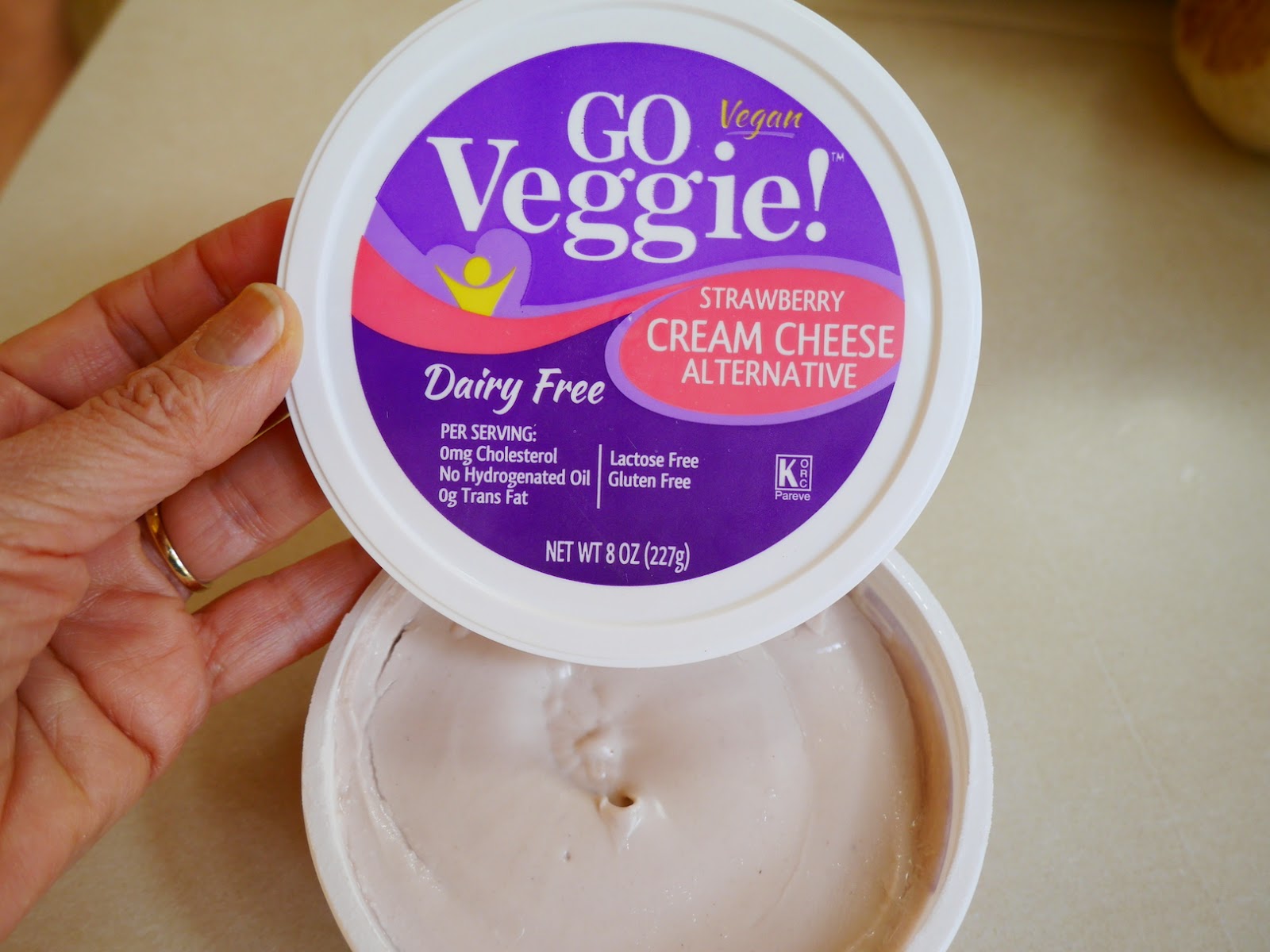
There are three dairy-free cream cheeses: Classic Plain, Chive and Garlic, and Strawberry. They are all very soft and spreadable. The Classic Plain has a nice mild flavor and spreads more easily than "Tofutti Better Than Cream Cheese" but Tofutti has more of the consistency and mouthfeel of dairy cream cheese. The Go Veggie Strawberry cream cheese makes a lovely bagel topping and I used the Chive and Garlic over a steamy baked potato.

2 Tablespoons of Go Veggie Classic Plain and Chive and Garlic Cream Cheese has:
90 calories
9 g total fat
4.5 g saturated fat
0 g trans fat
0 g cholesterol
1 g protein
0 g dietary fiber
120 mg sodium
Contains coconut and soy


Strawberry Cream Cheese has 80 calories, 7 g total fat, 3.5 g saturated fat, 0 g trans fat, 0 g cholesterol, 1 g protein, 0 g dietary fiber, and 105 mg sodium.

Parmesan Topping
Perhaps my favorite product is the Parmesan Style Topping because it really has the tangy, cheesy taste of Parm. Made from rice and soy, it has only 20 calories in 2 teaspoons and only 1 g of fat. The product clumps a bit but just shake it and all is well.


Fusilli and peas with Go Veggie Parmesan Style Topping.

"Cheese" Slices
Go Veggie has four different dairy and gluten-free cheese slices: Cheddar, American, Pepper Jack and Mozzarella. My favorite is Pepper Jack because it has a nice kick to it. The slices melt nicely and make a good grill cheese sandwich or good addition to any sandwich. Although I prefer to use the shreds, these slices would also melt in a casserole or mac and cheese. Each slice is extremely low in calories and high in calcium. The slices are a bit brittle and tend to break when removing them from their wrapper.

1 Slice has:
35 calories
2 g fat,
0 g saturated and trans fat, cholesterol
1 g protein
5 g carbohydrate
0 g dietary fiber
150 mg sodium
20% DV calcium
Gluten, dairy, and soy free


Grill "cheese" sandwich with Go Veggie Cheddar Slices

To find out where to buy Go Veggie products, just enter your City, State, or Zip code on their website.

Friday, April 10, 2015

Listeria Concern Prompts National Hummus Recall
Here's A Recipe To Make Your Own

Potentially deadly listeria found in samples of Sabra.

Sabra Hummus Recalled
Hummus is a staple for many, especially vegans and vegetarians, and Sabra is a very popular brand. The FDA posted a notice that Sabra Dipping Co. is voluntarily recalling about 30,000 cases of its Classic Hummus due to possible Listeria contamination.

Listeria monocytogenes can cause symptoms such as high fever, stiffness, severe headache, nausea, abdominal pain, and diarrhea in healthy individuals. For people with compromised immune systems, children, and the elderly, these infections can be fatal. Listeria infections are very dangerous for women who are pregnant and can cause miscarriages and stillbirths. It is critical that you check your refrigerator for the following five SKU's. Thankfully, to date, there have not been any reports showing that these products have caused anyone to become ill. Only the US is affected.

* Sabra Classic Hummus in 10-oz sizes - UPC/SKU 040822011143/300067 

* Sabra Classic Hummus in 30-oz sizes - UPC/SKU 040822014687/300074

* Sabra Classic Hummus without garnish in 32-oz sizes - UPC/SKU 040822342049/301216

* Sabra Classic Hummus in 17-oz six pack - UPC/SKU 040822017497/301290

* Hummus Dual Pack Classic/Garlic 23.5 oz - UPC/SKU 040822342209/301283

In the meantime, make your own hummus. Here's an easy recipe which is taken from my eBook, Health Begins in the Kitchen: Delicious and Easy Vegan Recipes and Seasonal Food Plan available on Amazon and iTunes. Hummus is so easy to make, you may never buy prepackaged hummus again!


            *                *                 *                  *

Classic Garbanzo Bean Hummus
Vegan, Dairy Free, Gluten Free
[makes 6 servings]

Requires a Food Processor, such as a Cuisinart.

Ingredients
1 (15-oz) can garbanzo beans, drained, liquid reserved
2 tablespoons sesame tahini
1 tablespoon cold pressed hemp oil or extra virgin olive oil
2 cloves garlic, chopped
1/2 teaspoon salt, or to taste
1/4 cup freshly squeezed lemon juice
Pinch cayenne (optional)
2 packed tablespoons chopped fresh parsley or cilantro

Directions
Combine all of the ingredients, except the parsley or cilantro, in a food processor with an S blade and process until smooth, occasionally scraping down the sides. If the mixture is too dry, add a small amount of the reserved bean liquid.

Add parsley or cilantro and pulse several times to combine.

Serve as a dip, a sandwich filling, or as a topping for your veggie burger.


Wednesday, April 01, 2015

Make Raw Vegan Gelato In Minutes
With Yonanas Elite, Nothing But Fruit!

Raw vegan cherry banana gelato.

Follow Foods For Long Life on Facebook and Pinterest.
Look Inside my eBook, Health Begins in the Kitchen.

Creamy Frozen Dessert
Would you believe that you can eat a frozen dessert with the creaminess of gelato and the calories and healthfulness of raw fruit? No, this isn't an April fools joke. I just bought a new kitchen toy that allows me to do just that! It's called Yonanas Elite. It couldn't be easier. 

Basically, you freeze fruit and run it through this machine. The creamy texture comes from perfectly ripened bananas and you add other fruits, etc. to give it different flavors and textures. You can even make desserts healthy enough to enjoy during a raw food cleanse!

Yonanas Elite

Recipes
The machine comes with a recipe book with lots of fun ideas. The combinations are endless and you will no doubt be creating some of your own using your favorite fruits. For convenience, you can buy a lot of different frozen fruits, like pitted cherries, mangos, strawberries, raspberries, etc. in the supermarket.

You can also make sorbets with frozen berries, oranges, pineapples, cantaloup, watermelon, apples and more. It's all in the recipe book and it couldn't be easier!


I think my favorite combination so far is bananas and cherries with walnut pieces and a few dark chocolate chips stirred in at the end.

One of the recipes in the book is green tea ice cream where you simply sprinkle matcha green tea on frozen bananas and then run them through the shoot. 

Making matcha green tea frozen dessert


Make a Raw Vegan Pie
This machine makes the perfect filling for a raw vegan ice cream pie. Just make a pie crust with Raw Vegan Dessert Helper and fill it with the frozen dessert of your choice. Put it in the freezer for at least 4 hours and take out to thaw for 20 minutes before serving.

Raw crust from nuts, coconut, dates, raisins and cinnamon.

I'm excited about trying more of the recipes in their book and creating some of my own. If you come up with some winning combinations, please share by leaving a comment on the blog. Thanks and enjoy!

Watch videos on the Yonanas website for more instruction on how to use this machine.


Wednesday, March 25, 2015

Make Thick, Creamy Vegan Yogurt With An Instant Pot Or Yogurt Maker - 5 Minutes Prep Time!
No Added Thickeners Or Gums Needed

Making this organic yogurt recipe couldn't be easier!

Follow Foods For Long Life on Facebook or Pinterest.
Download my eBook, Health Begins in the Kitchen.

I Love Yogurt
When I gave up dairy, yogurt was one of the things I missed the most. Store-bought vegan yogurt is pretty terrible. I remember a while back buying 8 different brands and types in order to do a product review for the blog. They contained all kinds of gums and binders, tons of sugar, and very little yogurt flavor. In disgust, I abandoned the article as I couldn't really find one that I was excited about recommending. 

I never tried making my own yogurt until I bought my Instant Pot. Although I use it mostly as a pressure cooker, it also works as a yogurt maker. So before I gave up on yogurt completely, with its healthful and critical probiotics, I thought I would give it a try.

Yogurt Starter
The first thing you need when making a non-dairy yogurt, is vegan yogurt starter. I use Cultures for Health. Check their website carefully for a coupon. They have other yogurt starters that are dairy based so if you can tolerate a tiny amount of dairy, you can try them too. I imagine that they might give a different flavor and consistency but I haven't experimented with them yet.

The vegan yogurt starter is a "direct set" or "single use" starter which means that you should use a new packet for every batch. With the particular recipe and non-dairy milk I am suggesting today, it is possible to make additional batches by using a 1/2-cup of the yogurt and whey from the previous batch. Eventually you may have to use a new packet (I found that using a fresh packet results in a slightly thicker yogurt) although my friend has made countless batches with yogurt and whey from her previous batches and hasn't noticed any differences.


To maintain culture strength, store in the freezer

Next, you'll need a non-dairy milk. My two favorites so far, that curdle and makes thick, creamy, spoonable yogurt without having to add any thickening agents, are Trader Joe's shelf stable organic unsweetened Soy Beverage and Kirkland's shelf stable organic, plain soy milk. Although the Kirkland's brand is organic and very delicious with just a hint of vanilla, the Trader Joe's product is a healthier choice because it just contains organic soy beans and water. Kirkland's contains other ingredients besides the soy milk like organic cane sugar, tricalcium citrate, sea salt, carrageenan, vanilla, natural flavors, vitamin A palmitate, vitamin D2, riboflavin and B12. Natural flavors can mean lots of nasty things and many nutritionists now recommend avoiding carrageenan because it can cause inflammation. 


Making yogurt is incredibly easy in your Instant Pot.
Stir starter into the milk, pour into jars, set time and hit start!


Nothing but soybeans!
A healthier choice than Kirkland's.

Soy Yogurt
Vegan, Dairy Free, Mostly Gluten Free*
[Makes 1 quart or 8 (1/2-cup) servings]
Requires 2 pint glass jars and an Instant Pot or other Yogurt Maker
Allow 8 to 12 hours in yogurt maker and several hours to refrigerate

Ingredients
1 quart shelf-stabilized plain organic soy milk, room temperature
1 packet of Cultures for Health vegan yogurt starter**

*Cultures for Health Vegan Yogurt starter may contain traces of gluten as they use barley as a nutrient for the probiotic.
** Or try using a 1/2 cup of yogurt and whey from your previous batch

Directions
Clean glass jars with soap and hot water. Dry and set aside.

Pour the room-temperature soy milk into a clean pitcher. Sprinkle in a packet of yogurt starter and stir well. If you are using 1/2 cup of yogurt and whey from a previous batch (instead of a packet of yogurt starter), place that into the pitcher first and slowly mix in the quart of milk until it is well combined.

Pour into two pint jars. If you have a little left over, pour it into a small taster jar.

Place all jars into the Instant Pot. Push the "yogurt" button and set for 8 to 10 hours (the longer, the tangier). You may use the cover that comes with the Instant Pot or a 9" snug-fitting glass lid. I like using a glass lid so that I can see what's going on. 

Remove when done and place in the refrigerator. Serve when chilled.

Tip: Prepare it in the morning so that it finishes in the evening and you can pop it into the refrigerator before you go to bed. Then it will be chilled and ready to use for breakfast the next morning. 

Nutrition (using Kirkland)
Per 1/2-cup serving: 50 calories, 2 g total fat, 0.3 g saturated fat, 0 mg cholesterol, 4 g protein, 4 g carbohydrates, 0.5 g dietary fiber, and 55 mg sodium.

Nutrition (using Trader Joe's)
Per 1/2-cup serving: 45 calories, 2.3 g total fat, .3 g saturated fat, 0 mg cholesterol, 4.5 g protein, 2 g carbohydrates, 1 g dietary fiber, and 43 mg sodium. 

Making Yogurt from Almond, Coconut and Rice Milk
I have not been successful making yogurt from other non-dairy milks such as almond, coconut, and rice milk as they require a thickening agent. Often, the resulting yogurt is more like Jello than creamy and curdled yogurt. I also don't think they are as tart. Recently, however, I have found some store bought products that are pretty good. Check out my product review on Cashew, Almond, and Coconut Milk non-dairy yogurts. 


If you want to try making these on your own, your best bet is to use a recipe using Pomona's Universal Pectin.  I find that there is no need for the calcium water called for in the recipe if the non-dairy milk you are using has sufficient added calcium. 

Experimenting is Fun!
Experimenting with different milks and yogurt starters is fun so if you come up with some great creations, please share them with us!

Check out my product review on Cashew, Almond, and Coconut Milk non-dairy yogurts!


Monday, March 16, 2015

Can Adding Fish To A Vegetarian Diet Significantly Lower Risk Of Number Two Cancer Killer?

Study shows adding salmon to a vegetarian diet
significantly lowers risk of colorectal cancer.

Follow Foods For Long Life on Facebook and Pinterest.

Colorectal Cancer Risk and Diet
Last week there was a lot of attention given to a recent study that showed a dramatic decrease in colorectal cancer risk for people following plant-based diets, especially those that included fish. This is significant because colon cancer is the second leading cause of death in men and women combined in the United States (lung and bronchial cancer is the top killer.) 

The Study
Researchers at Loma Linda University did an analysis on 77,659 people. After 7 years, 490 of the participants in this study had colorectal cancer. Review of the participants' food frequency questionnaires revealed that those who ate a vegetarian diet had a 22% lower risk of colorectal cancer than those who were non-vegetarians and consumed meat at least once a week. 

But the results are far more dramatic when you look at the type of vegetarian diets the participants followed.

* Semi-vegetarians (ate meat less than once a week) were 8% less likely to develop colorectal cancer.
* Vegans (ate no meat, seafood, eggs or dairy) had a 16% reduced risk.
* Lacto-ovo vegetarians (ate eggs and milk products but no meat and seafood) had an 18% reduced risk.
* Pescavegetarians (vegetarians who also ate fish) were 43% less likely to develop the disease!

These are pretty startling numbers. Several things stand out.
* Eating even small amounts of meat (semi-vegetarians) appears to reduce the benefit of a vegetarian diet with respect to lowering the risk of colorectal cancer by 8 to 10 percent.
* Adding fish to a vegetarian diet seams to significantly increase protection against this dreaded disease.

Why is a Vegetarian Diet Protective?
There are countless studies that suggest that eating a diet rich in vegetables, fruits, whole grains, nuts and seeds protects against cancer, heart disease, and other diseases. With these healthful foods comes a natural source of dietary fiber, vitamins, minerals and phytonutrients linked to better health and longevity. I personally think dietary fiber is key. Although some studies have had mixed results trying to link high fiber diets to a lower risk of colon cancer, to me it is common sense that anything that helps potential toxins move through the GI tract more swiftly is going to do this.

The Benefits of Fish 
Certain forms of omega-3 fatty acid and vitamin D, that are plentiful in fish, are often linked to the prevention of cancer and a host of other diseases. Unfortunately, except for a small amount of vitamin D contained in some mushrooms, these nutrients are not found in plants.
Omega-3
Vegans and vegetarians get plenty of omega-3 from chia, hemp and flax seeds as well as other plant sources. But these are short-chain alpha-linolenic, ALA, fatty acids. The long-chain omega-3 fatty acids, EPA (eicosapentaenoic acid) and DHA (docosahexaenoic acid) are found in fish and shellfish. EPA and DHA have more potent benefits than ALA and although the body can derive these beneficial omega-3 fatty acids from ALA, it doesn't do this efficiently or sufficiently. 

Why is omega-3 important? Numerous studies have shown that omega-3, especially from fish, reduces the inflammatory process that leads to many chronic diseases such as cancer, heart disease, autoimmune diseases such as rheumatoid arthritis, asthma and more. It has also been shown to protect against depression, cognitive decline, and attention deficit and hyperactivity disorder (ADHD). Adding fish to a vegetarian diet, with its contribution of EPA and DHA omega-3 fatty acid, most certainly contributed to the decreased risk of colorectal cancer in this study. 

Vitamin D
Other studies have shown that vitamin D is effective in colorectal cancer prevention so perhaps the contribution of this nutrient from the fish consumed in this study lead to similar prevention. 

In one such study, PhD researcher Edward Gorham revealed, after examining the data from five observational studies, that by increasing the serum level of vitamin D to 34 ng/ml, the incidence of colorectal cancer could be reduced by half. He reported, "We project a two-thirds reduction in incidence with serum levels of 46 ng/ml, which corresponds to a daily intake of 2,000 IU of vitamin D. This would be best achieved with a combination of diet, supplements and 10 to 15 minutes per day in the sun." 


Spend a little time each day enjoying the sunshine but
 diet sources and supplements are also suggested.

Vitamin D Supplements
The vitamin D council recommends supplementing with vitamin D3 since that is the form produced by the skin in response to sunlight and certain studies claim higher efficacy than other forms. However, D3 is derived from lanolin and is not vegan. Vitamin D2 is the vegan form.

Some Fish Provide Both Omega-3 and Vitamin D
Salmon, trout, herring, anchovies and sardines are good low-mercury sources of EPA and DHA omega-3 fatty acids as well as vitamin D. 

What To Do?
To minimize your risk of colorectal cancer, consider the following:

* Avoid eating meat, especially red or processed meat.

* Eat a plant-centric diet packed with vegetables, fruit, whole grains, nuts, and seeds. It's always best to eat organic and non-GMO when possible.

* Eat low-mercury, high omega-3 fish, such as wild salmon, to get beneficial EPA and DHA omega-3 fatty acids into your diet. Bake or broil but NEVER deep-fry fish. 

If you are a vegan or vegetarian for ethical reasons and will not consider eating fish, then you can get what you need from vegan micro-algae oil. Deva makes a 300mg DHA and EPA supplement. These tend to be pricey and don't contain nearly as much as a piece of fish. It takes 5 of these capsules to get as much omega-3 fatty acid as one 3 ounce piece of salmon. But it's a good and necessary solution if you are opposed to eating fish.

Since omega-3 reduces inflammatory responses that lead to disease, you can take a simple C-Reactive Protein (CRP) test to evaluate the level of inflammation in your body. It's a great indicator for heart disease (much better, in my opinion, than cholesterol), cancer, and many other degenerative disorders. You can also test your level of DHA and EPA by taking a blood test to see if your body is adequately converting ALA to these more potent forms of omega-3.

* Besides eating fish, get vitamin D from sunlight and supplements. I personally take 2,000 IU per day. When I spend more time indoors in the winter, I increase it to 4,000 IU. Vegans can easily get what they need from the sun and supplements as well as fortified foods. Most non-dairy milks are fortified with vitamin D. 

But don't always count on the sun to give you what you need. People with darker skin, or those who wear sun block, who are older, and who live further from the equator are more likely to be deficient. In fact, MOST people are deficient in this critical nutrient! To understand if you are, take a 25-hydroxy vitamin D test. According to the vitamin D council, a sufficient result is between 40 to 80 ng/ml. According to the National Institutes of Health, the normal range is 30 to 74 ng/ml.

Summary
I write this blog because I believe that diet has a powerful effect on our health. This gives us a lot of control over the quality of our life, even if we have less than stellar family genes. Studies such as this should encourage us to refine our diets even further to optimize our health. 

Many of my readers are vegans for reasons of compassion and can take this information and adjust their diets with supplements and sunshine to optimize their health. 

For those of you not opposed to eating fish and who are trying to develop the healthiest diet possible, you may want to consider a well-designed pescavegan or pescavegetarian diet that can provide the fish, fiber and critical nutrients needed for excellent health.


Salmon Recipes
Salmon, one of my Top 20 Foods for Health and Longevity, is very low in mercury and packed with EPA and DHA omega-3 fatty acids. Here are three easy and delicious salmon recipes you might enjoy:
Baked Atlantic Salmon with Roasted Onions and Cherry Tomatoes on Wilted Spinach, or Mango and Black Bean Salsa with Honey Lime Baked Salmon, and Baked Honey Mustard Coho Salmon.


Baked Honey Mustard Coho

Thursday, March 12, 2015

Easy Vegan Instant Pot Split Pea Soup With Shredded Carrots - No Blending Required

Split pea soup has never been easier using an Instant Pot.

Follow Foods For Long Life on Facebook and Pinterest.

So Easy in an Instant Pot
Split pea soup is my "go-to" meal in the winter. It's hardy and delicious and a great source of fiber and plant-based protein. At less than 300 calories per generous serving, this recipe has a whopping 21 grams of dietary fiber and 19 grams of protein.

There are many ways to make split pea soup. Traditionally you cook it until the peas start to break apart and then you place it in a blender or use an immersion blender to get a nice smooth soup. Or you serve as is in a more rustic version of the recipe. Both are excellent but require a lot of stirring and, should you decide to blend, the trouble of doing another step and having to clean up more tools. (If you don't have an Instant Pot, see my Vegan Split Pea Soup and Carrots recipe that requires a blender.)

But to my delight, I've created a way to make this awesome soup with absolutely no trouble at all. Just pop all the ingredients in an Instant Pot Electric Pressure Cooker, set for 12 minutes, and your have a pretty smooth soup without any stirring or blending. Including the  heat-up time and a slow release time, it takes a total of about 1 hour with absolutely NO effort at all. After it cooks, I stir some shredded carrots into the hot broth and they cook almost instantly.

Here's the recipe!

            *                      *                      *

Instant Pot Split Pea Soup
Vegan, Dairy Free, Gluten Free
[makes 6 servings]

Requires an Instant Pot Electric Pressure Cooker

Ingredients
1 pound (~2 cups) dry split peas
8 cups hot water
1 Rapunzel vegetable bouillon cube with herbs
1 onion, chopped
3 stalks celery, diced
1 teaspoon extra virgin olive oil
1/2 teaspoon granulated garlic
1/4 teaspoon black pepper
Salt to taste
1 bay leaf
2 carrots, peeled and coarsely shredded
1 or 2 tablespoons fresh lemon juice (optional)

Directions
Pick through the split peas for small rocks or dirt and rinse well, in a strainer, under cold water.

Place the rinsed split peas in the Instant Pot along with all the rest of the ingredients except the carrots and lemon juice. Stir a bit to get the bouillon cube mixed into the hot water. 

I like to use water and a Rapunzel bouillon cube because it gives a nice flavor and usually provides enough salt but you can substitute the water and bouillon with veggie broth.


As a note, the olive oil is added to keep the peas from frothing and clogging up the pressure cooker. 


Place all ingredients in the pot except carrots.

Secure the lid and make sure the top vent is closed. Hit the manual button and set for 12 minutes.


When done, let the pressure release naturally. When complete, remove the lid carefully, with the steam pointed towards the back.

Add the shredded carrots immediately and stir well until the soup is smooth. It may seem a bit thin but this soup thickens as it cools. Adjust for seasonings, adding salt to taste and additional black pepper if needed. To brighten the taste, you can also stir in a tablespoon or two of freshly squeezed lemon juice.


Do not shred the carrots too thinly.


The shredded carrots will cook immediately in the hot soup.

Serve as is or over rice.

When you put the leftover soup in the refrigerator it will become solid. To reheat, you may need to add additional water. 

Nutrition
(Per serving - 6) 291 calories, 2 g total fat, 0.7 g saturated fat, 70 mg omega-3 and 427 mg omega-6 fatty acids, 0 mg cholesterol, 19 g protein, 50 g carbohydrates, 21 g dietary fiber, and 379 mg sodium.